



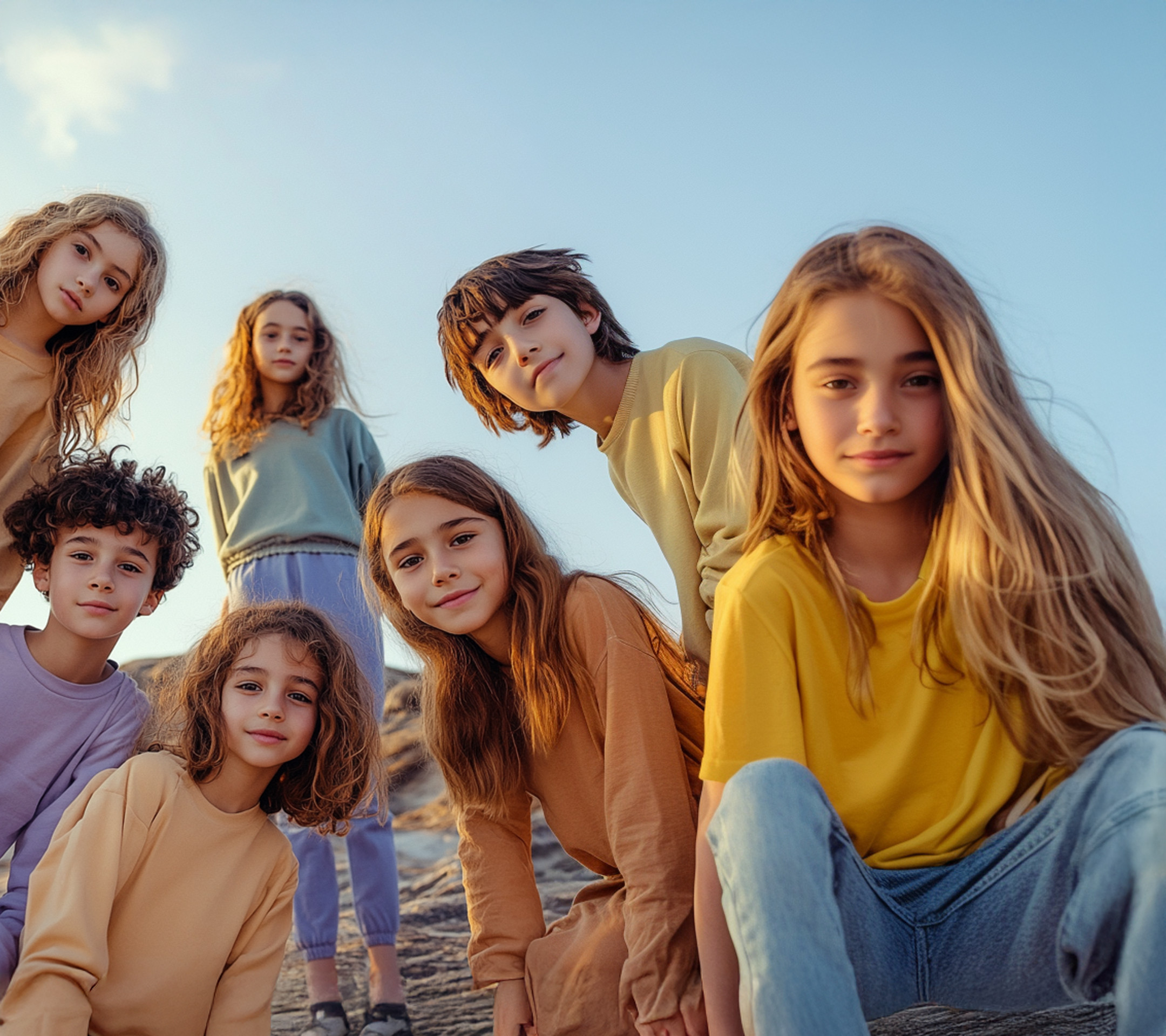
From 11 to 13 years of age, kids undergo a period of deep change: questions become more frequent, their identity is defined, personal passions and inclinations emerge. School ceases to be just a place where you learn skills, but also one where you learn to orient yourself, choose, and see how you match up to the complexity of the world.
At Rootes Middle this path is intertwined with the bicultural project which has accompanied the students since the kindergarten and primary school. The marriage between Italian conceptual rigour and Anglo-Saxon pragmatism becomes an opportunity to develop critical thought, autonomy, an ability to analyse, and a connecting of different branches of knowledge. It’s the moment when roots become routes: new directions which lead the kids towards adolescence and beyond.
The didactic journey brings together the Italian National Indications and the English National Curriculum, thereby offering students recognised and sound training.
Rootes Middle’s teaching is never a simple accumulation of ideas, but a path which holds together experience, reflections and study. Inquiry-based learning, cooperative learning, the STEAM interdisciplinary approach and Outdoor Education intertwine to produce a method which trains sound and across-the-board skills.
A science lesson may become a research project to share in the Agora; a mathematical problem can link in to technology and art; a theatre workshop can turn into an opportunity to discuss history, society and current affairs. Learning thus takes the form of a dynamic and collective process which prepares kids not only to know things but also to create solutions and look to the future with creativity, flexibility and a critical spirit.
Lessons are often conducted in co-teaching by Italian and mother-tongue English teachers together, which enables a dialogue between the two cultures to emerge, and turns their differences into an opportunity to learn.
Every school day opens with the
Rootes Middle’s linguistic path culminates with the most important objectives for bilingualism.
The students measure their abilities against Trinity ISE II at the end of the 3rd Middle, an exam which corresponds to level B2 of the Common European Framework – which is that required of a university student. It’s a result which represents a real competitive advantage, the result of daily bilingual practice and of a continuous progression from Trinity Stars (in the first classes of the primary school) and GESE (in 3rd primary).
The certification does not produce just certificates, but is an experience which strengthens confidence, motivation and awareness of the journey undertaken. The value of the bicultural project is made clear, and an international future is opened up to the students.
At Rootes Middle, knowledge is always linked to reality. School outings, work experience and training courses in Italy and abroad enable the students to compare historical, artistic and environmental heritage, to enjoy intercultural experiences and measure themselves against authentic contexts.
Workshop activities, research projects, sport and expressive arts enrich the curriculum and offer everyone the chance to cultivate personal interests and discover new passions. The school thereby becomes an open and dynamic place, in constant dialogue with the area and the world.
Rootes Middle’s physical structure is designed as a setting for fluid and interconnected learning. It follows the model of the ‘4 spaces +1’: the Agora for collective comparisons, the research areas for collaborative work, the spaces to present and share, the corners set aside for personal study and the digital setting which connects and integrates all of the others.
This organisation enables the kids to be autonomous, choose manners and times, experiment with different roles and develop a sense of responsibility. The spaces do not simply contain didactic activities, they generate them, and become an integral part of the method.
The weekly schedule of the Middle College is organized into 36 class periods of 45 minutes each, structured as follows:
| Subject | Italian | English | Spanish |
|---|---|---|---|
| Italian Language and Literature | 6 | – | – |
| History | 1 | 1 | – |
| Geografia/Global Perspectives | 1 | 1 | – |
| English, Anglophone Literature, and Drama | – | 7 | – |
| Spanish | – | – | 2 |
| Maths | 2 | 2 | – |
| Science | 1 | 1 | – |
| Technoly/ICT | 1 | 1 | – |
| Art | – | 2 | – |
| Music | – | 2 | – |
| P.E. | – | 2 | – |
| Religious Education / Alternative Activity | – | 1 | – |
| TOTAL | 12 | 22 | 2 |
The school day runs from 8:15 a.m. to 1:45 p.m., with two 15-minute breaks at 10:15 and 12:00. Lunch, which is optional, takes place from 1:45 to 2:30 p.m. In the afternoon, from 2:30 to 4:00 p.m., there are:
2) 2 days with two afternoon lessons;
2) 1 day with a 90-minute sports afternoon;
3) 2 days with optional 90-minute sessions for two tutoring programs (S.T.E.M. and Humanities)